

In the waning seconds of a game that had already carved deep grooves into the hardwood of Indianapolis, LeBron James did what only a select few in the annals of basketball history have managed to do—bend time itself. The Lakers, spiraling in the throes of a three-game losing streak, needed a miracle. And when the air inside Gainbridge Fieldhouse thickened with anticipation, James, the 39-year-old maestro, wrote another chapter of inevitability.
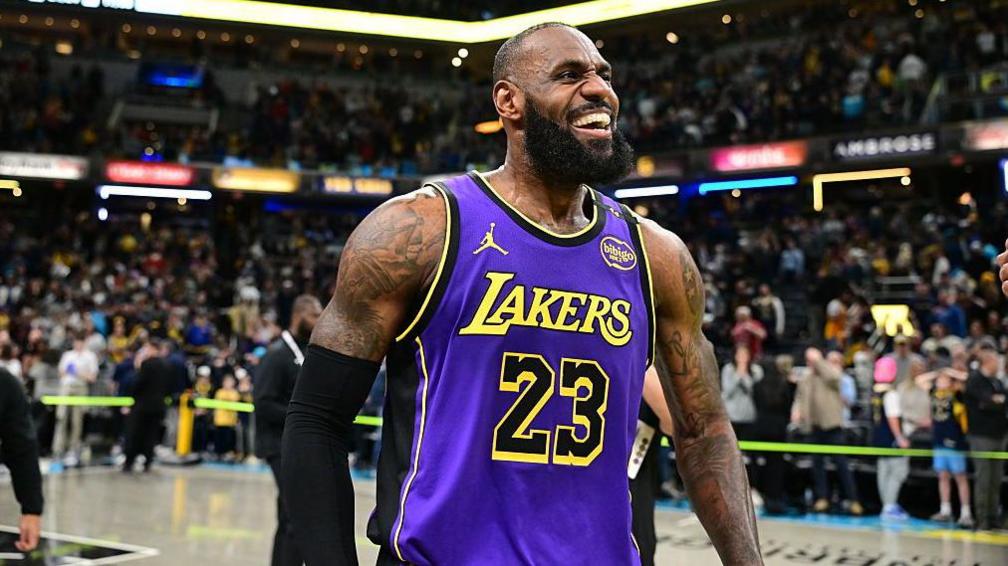
A Luka Doncic miss, a ball suspended in mid-air like a question waiting for an answer, and then—James, defying the logic of fatigue and age, leaping into the frame as if reality had momentarily loosened its grip. A perfectly timed tip-in, a flick of providence, and suddenly, the scoreboard flickered: 120-119. Game. Set. James.
The Psychology of Clutch: Why Greatness is Never an Accident
What separates James from the merely talented? The casual observer sees a well-executed play, but the architect of greatness understands the deeper mechanics at play. The moment itself was not a singularity; it was the culmination of years of instinct refinement, an in-depth mastery of spatial awareness, and an unparalleled capacity for poise under pressure.
There is a psychological framework that governs these moments—what sports scientists call ‘situational dominance.’ It’s the ability to process chaos with the clarity of a grandmaster in chess, to see beyond what is and into what must be. James has mastered this art, not by chance but by an almost militant dedication to conditioning, both physical and mental.
J.J. Redick, now navigating the murky waters of coaching, put it succinctly: “He gets rewarded by the basketball gods because he didn’t let go of the rope and didn’t stop competing.” But it’s more than just divine intervention—it’s an alchemy of resilience, a calculated defiance of entropy.

The Aging Warrior and the Unfinished Battle with Time
LeBron’s fourth-quarter eruption was a stark contrast to the first three, where his offensive silence was as deafening as the critics who have long questioned his longevity. Yet, in an era where players peak and fade like passing seasons, James is redefining what it means to endure.
Consider this: At an age where most stars have long accepted the dimming of their light, he is still dictating outcomes in the most ruthless theater of competition. He is not playing against his peers anymore; he is playing against history itself. And in moments like these, when the clock is gasping its final breaths, he reminds the world that the greatest adversary he has ever faced isn’t an opposing defender—it’s time itself.
The Ripple Effect: Why This Moment Matters Beyond the Lakers’ Win
It would be easy to see this as just another regular-season victory, another notch in the relentless march toward the playoffs. But this is where narratives stretch beyond the immediate. Every touch, every strategic pivot, every final-second adjustment—these are the brushstrokes in a much grander painting.
The Pacers, holding a one-point lead with 42 seconds remaining, were poised to secure a statement win. But this is the thing about basketball—it is not about how long you lead, but about who has the final say. And on this night, James authored the final word with the ink of his own defiance.

A Legacy in Motion: What Comes Next?
The Lakers, now 44-28, inch closer to a postseason battle that will demand even more acts of defiance. The Western Conference, an unforgiving battlefield, will not accommodate sentimentality. Yet, if history has taught us anything, it is that James thrives in these crucibles.
Beyond him, the league pulses with other narratives—Doncic’s scoring brilliance, Jokic’s statistical wizardry, and the dogged resilience of teams clawing their way toward playoff security. Yet, there is something uniquely mesmerizing about witnessing a player, long thought to be in the twilight of his career, still altering destinies with a single motion.
The story of LeBron James is not yet finished. And as long as there is time left on the clock, he will continue to remind us why greatness is not given but relentlessly taken.


