

A Moment of Madness or a Calculated Message?
Football, in its purest essence, is a ballet of emotions wrapped in raw athleticism. It’s a battlefield where sweat meets skill, where artistry collides with aggression. And sometimes, even the greatest to ever grace the pitch momentarily forget the thin, fragile boundary between intensity and indiscretion.

Such was the scene when Lionel Messi, an icon of grace and composure, momentarily let his emotions bubble over in an uncharacteristic display of aggression. The moment came in the dying embers of a feisty clash between Inter Miami and New York City FC, a game that saw its fair share of controversy. As the final whistle echoed, Messi placed his hand on the neck of NYCFC assistant coach Mehdi Ballouchy—a gesture that, in the eyes of the league’s Disciplinary Committee, warranted a fine. An undisclosed amount, but a fine nonetheless.
But was this truly a moment of unchecked passion? Or was it a subconscious assertion of dominance, a message that even in the twilight of his career, Messi refuses to be slighted? After all, football has long been a sport where authority is challenged not just with the ball at one’s feet, but with body language, glances, and gestures that transcend mere words.
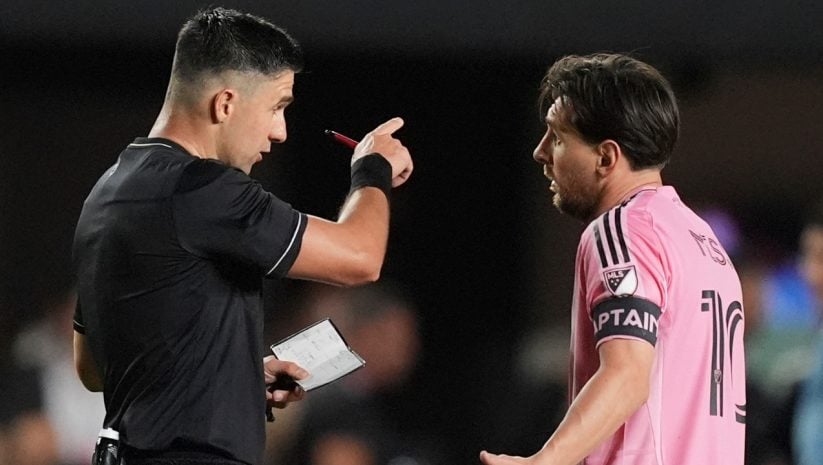
The Psychological Warfare of Football’s Elite
Messi is not a player known for physical altercations. Unlike some of his contemporaries, he has built his legacy on vision, precision, and an almost supernatural ability to glide past defenders. Yet, this act—however brief—suggests something deeper.
Great athletes are not immune to frustration, but they also understand the power of presence. The neck grab, subtle yet deliberate, is an act rooted in primal psychology. In ancient combat, warriors seized their opponents by the neck not merely to restrain, but to assert control. It is a subconscious cue of authority, an instinctual flex of dominance.
Could this moment have been Messi’s way of reminding the world that even in the rough-and-tumble of the MLS, he is no ordinary player? That he will not be pushed around or subjected to the same treatment as the rank and file of footballers who come and go?

When the Rules Collide with the Icons of the Game
The MLS, in its bid to maintain discipline, handed out a fine—an action that seems bureaucratically necessary rather than morally imperative. Fines, after all, are a league’s way of posturing, of showing that no player—no matter how legendary—is above the law. But do fines in cases like this truly serve justice, or do they merely reinforce a facade of control?
Consider the case of Luis Suárez, Messi’s longtime friend and teammate, who was fined for a similar infraction in the same match. Suárez, unlike Messi, has a history of fiery antics. For him, the aggression might have been expected. But Messi? This was something new, something rare—an anomaly in a career of impeccable sportsmanship.

And therein lies the paradox: when the giants of the game exhibit human flaws, the world doesn’t quite know how to react. Should we condemn them for a brief lapse in composure, or should we acknowledge that even the best have moments where the fire within momentarily flares too bright?
A Match That Refused to Be Tamed
Beyond the fines and disciplinary actions, the match itself was a microcosm of football’s unpredictable beauty. Miami, reduced to ten men in the first half, clawed back to secure a 2-2 draw, with Messi playing a pivotal role yet again. Despite the controversy, his two assists proved decisive, culminating in Telasco Segovia’s dramatic equalizer.
Messi would return to action in the CONCACAF Champions Cup just days later, scoring yet again in a 3-1 victory. Because that’s what legends do—they endure, they respond, they continue to write new chapters even as critics attempt to dissect the past ones.

The Verdict: A Moment, Not a Legacy
For those quick to condemn Messi’s action, a reminder: football is emotion. It is the grand theatre of passion, heartbreak, redemption, and sometimes, raw human instinct. This was not Zidane’s infamous headbutt in 2006, nor was it Cantona’s kung-fu kick. This was a moment—a flicker of passion, quickly extinguished, and unlikely to be repeated.
Messi will move on, just as football always does. The fine will fade into a footnote, a minor punctuation mark in the lengthy manuscript of his storied career. But for those who witnessed it, the message was clear: even the greatest are human, and sometimes, even a lion must roar.


