

In the realm of football, where greatness is measured in silverware and history is etched by those who dare to defy the odds, there exists a rare and mythical achievement—the treble. A conquest so formidable that only eight teams have managed to engrave their names into the annals of footballing immortality. Winning the domestic league, the primary national cup, and the most coveted prize of all—the European Cup—in a single season is no mere feat; it is the pinnacle of club football, the Everest of the beautiful game. And yet, Real Madrid, the undisputed kings of European football, have never ascended this peak.

As the 2024-25 season keep unfolding, Madrid eyes this impossible dream, a quest that has devoured even the greatest. But before we venture into their aspirations, let us journey through the chronicles of those who have conquered the unconquerable.
Celtic’s Lisbon Lions: The Pioneers of Glory
In an era when Scottish football was still a formidable force, Celtic shattered expectations and carved their place in history. The 1966-67 season saw the Hoops claim the treble, led by the brilliance of Jimmy Johnstone and the prolific Bobby Lennox. But their crowning moment came in Lisbon, where they defeated the mighty Inter Milan to lift the European Cup, earning them the moniker Lisbon Lions. Not content with just three trophies, Celtic went a step further, adding the League Cup and the Glasgow Cup, proving their absolute dominance. They were not just champions; they were revolutionaries.

Ajax’s Total Football: The Revolution of an Era
If football were poetry, Johan Cruyff’s Ajax of 1971-72 would be its most profound verse. Under the tactical brilliance of Stefan Kovacs, who inherited Rinus Michels’ Total Football ideology, Ajax not only swept through the Dutch league and cup but also dismantled Europe’s elite. With names like Neeskens, Krol, and Rep, they played football of the future, decades ahead of its time. Their victory in the European Cup was not just a triumph; it was a declaration—football would never be the same again.

PSV’s Grit and Guile: The Underdog Triumph
If Ajax was elegance, PSV Eindhoven’s 1987-88 treble was pure resilience. Managed by Guus Hiddink, they marched through the Eredivisie and Dutch Cup with authority. But it was in the European Cup that they showcased their unbreakable spirit, drawing their last five matches, including a nerve-wracking semifinal against Real Madrid. In the final, it came down to penalties, where Hans van Breukelen’s heroics sealed their place among the elite. It was not the most beautiful treble, but it was undoubtedly one of the grittiest.
Manchester United’s Miracle in Barcelona
There are stories in football, and then there is Manchester United’s treble-winning campaign of 1998-99. Sir Alex Ferguson’s side clawed their way to the Premier League title, edged past Arsenal in a legendary FA Cup semifinal, and then delivered the most astonishing comeback in Champions League history. With Bayern Munich seconds away from victory, Teddy Sheringham and Ole Gunnar Solskjær scripted an ending so surreal that it felt scripted by the football gods themselves. “Football, bloody hell,” Ferguson famously said. The treble was not just won; it was snatched from the jaws of despair.

Barcelona’s Twin Dominations: Messi’s Era of Supremacy
If any team in history has mastered the art of dominance, it is Barcelona. Not once, but twice, they reached football’s highest summit. In 2008-09, Pep Guardiola assembled a squad that played with such surgical precision that the game itself seemed redefined. Xavi, Iniesta, and an unstoppable Lionel Messi orchestrated a symphony of destruction, claiming all three trophies with breathtaking ease.
Then, in 2014-15, under Luis Enrique, the MSN trio—Messi, Suárez, and Neymar—delivered another treble, ruthlessly dispatching every challenger in their path. It was not just history; it was inevitability.

Mourinho’s Inter: The Dark Arts of Victory
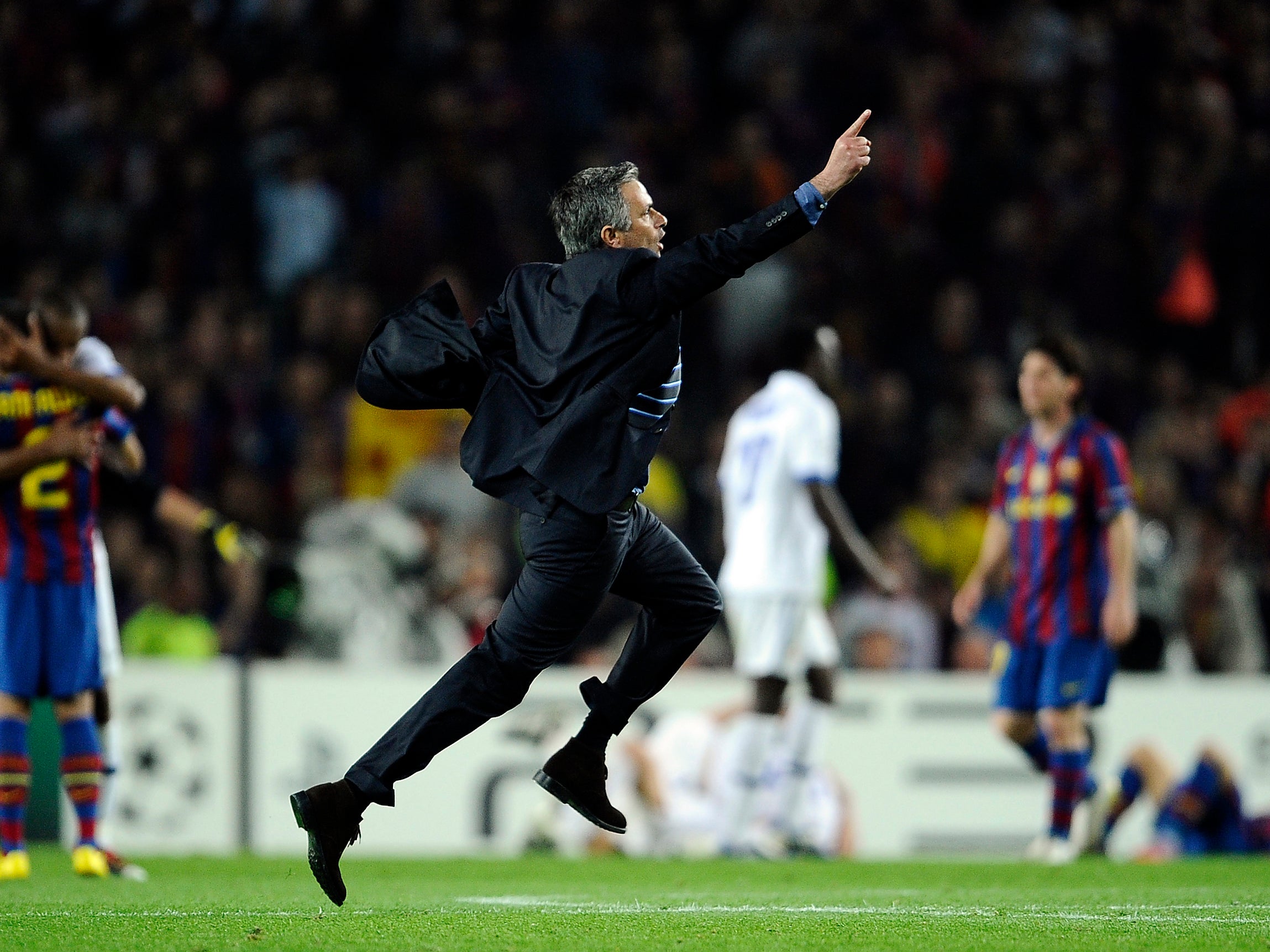
Jose Mourinho is a man who thrives on adversity, and his 2009-10 Inter Milan side embodied his philosophy. They were warriors, uncompromising and lethal. Having eliminated Guardiola’s Barcelona in a clash of ideologies, they went on to conquer Bayern Munich in the final. That night in Madrid, Mourinho wept—not for the victory, but for the war he had won against the footballing establishment.
Bayern Munich: Ruthless Efficiency, Twice Over
Bayern Munich’s 2012-13 treble was a testament to their brutal efficiency. They crushed Barcelona 7-0 over two legs in the Champions League semifinals before defeating Borussia Dortmund at Wembley. And in 2019-20, amidst the chaos of the pandemic, they repeated history, dismantling every opponent—including an 8-2 annihilation of Barcelona. Hansi Flick’s side were relentless, a machine fine-tuned to perfection.

Manchester City’s Modern Masterpiece
For years, Pep Guardiola sought the one trophy that had eluded him since leaving Barcelona. In 2022-23, he finally found it. Manchester City, a team sculpted in his image, dominated English football and then conquered Europe, ending their long-standing Champions League drought. The final was won by the smallest of margins, but the statement was monumental: Guardiola had done it again, becoming the only manager to win the treble with two different clubs.

Real Madrid: The Last Great Conqueror Yet to Conquer
And so, we return to Madrid. The club that has defined European football like no other. The club of Di Stéfano, of Puskás, of Zidane, of Cristiano Ronaldo. The kings of the Champions League, but never the rulers of the treble. They have come close—so agonizingly close—but the stars have never aligned. Yet, if history has taught us anything, it is that Real Madrid does not chase records; they create them.

As the 2024-25 season unfolds, the world watches. Will Madrid finally add the treble to their colossal legacy? Or will the dream remain just that—an impossible dream? Only time will tell. But if football has proven anything, it is that nothing is truly impossible.
The treble awaits. Who will rise to claim it next?


