

Boxing heavyweight legend George Foreman has died aged 76.
Known as Big George in the ring, the American built one of the most remarkable and enduring careers in the sport, winning Olympic gold in 1968 and claiming the world heavyweight title twice, 21 years apart – the second making him the oldest champion in history aged 45.

There are men who fight, and there are men who transcend the fight itself—becoming something greater than their fists, something eternal. George Foreman is not merely a two-time heavyweight champion. He is a case study in reinvention, an odyssey of triumph, defeat, faith, and entrepreneurial genius.
This is not just a boxing story. It is a parable of resilience, an allegory of the underdog, and a masterclass in turning adversity into a cathedral of opportunity.
Genesis of a Giant: The Birth of a Powerhouse
At 19, a raw and unpolished Foreman bulldozed his way through the 1968 Olympic boxing tournament in Mexico City, leaving opponents sprawled and bewildered. The gold medal wasn’t just an accolade—it was a coronation. A coronation of raw power, untamed aggression, and the promise of a future that seemed as inevitable as the rising sun.
When Foreman turned pro, he did not tiptoe into the heavyweight division—he obliterated it. Thirty-seven consecutive victories, many by knockout, announced the arrival of a new kind of force. A force that would collide, inevitably, with the reigning king.
The King That Fell: Frazier’s Nightmare in Kingston
In 1973, Foreman faced the indomitable Joe Frazier, a man who had survived 15 brutal rounds with Muhammad Ali in the “Fight of the Century.” But in Kingston, Jamaica, survival was not an option. Foreman turned the canvas into a graveyard, knocking Frazier down six times in two rounds. It wasn’t just a victory—it was an execution. The world had seen power before, but never like this.
Foreman was no longer just a champion. He was a force of nature. The undefeated titan, the juggernaut no one could stop.
Or so it seemed.
The Rumble in the Jungle: When the Goliath Fell
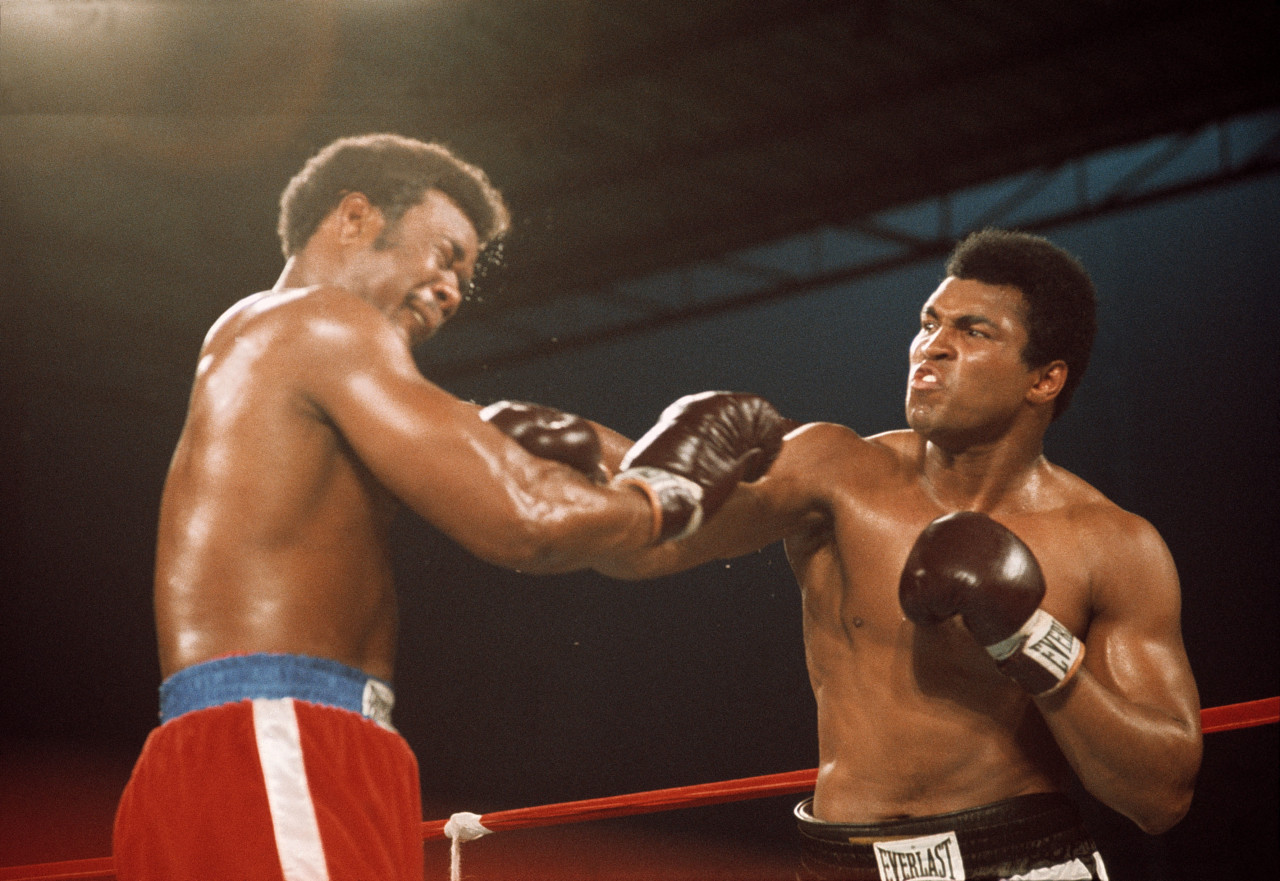
The mythology of boxing is incomplete without Kinshasa, Zaire. In 1974, the world watched as Foreman entered the ring as the indestructible monster against Muhammad Ali—the faded legend, the 32-year-old former champion who had lost his prime to exile.
The outcome seemed inevitable. The Vegas odds were merciless. “Foreman in one,” experts said. “Maybe two.”
But there are moments in history when wisdom outmaneuvers might, when strategy topples strength. That night, Ali unveiled what would become one of the most legendary tactics in sports: the rope-a-dope.
Foreman threw punches in a torrent of destruction. Ali, against all logic, leaned on the ropes, absorbing the blows, whispering to Foreman, “Is that all you got, George?”
By the eighth round, exhaustion swallowed the giant whole. Ali struck. A right hook, a combination, a final hammer of a punch. Foreman fell. The world gasped.
It was the night a titan crumbled.

The Dark Night of the Soul: From Fighter to Preacher
Most men do not recover from public humiliation of this magnitude. The fall from Olympus is often permanent. But Foreman’s story was never about defeat—it was about rebirth.
After a second professional loss, Foreman shocked the world by retiring in 1977. The boxer became a preacher, spreading the gospel in Texas, his once-destructive hands now building churches instead of breaking men.
What did he learn in that loss? In an interview decades later, Foreman said it was the “best thing that ever happened to me.” For the first time, he saw beyond boxing. Beyond the titles. Beyond the belts.
But fate was not done with him yet.

Resurrection: The Old Man Who Became King Again
In 1987, a 38-year-old George Foreman stepped back into the ring. It was not just a comeback—it was an act of defiance against the laws of time.
He was slower, heavier, mocked by critics. But beneath that bulk was something more dangerous than youth: experience. Wisdom.
He racked up 24 wins before facing Evander Holyfield in 1991. Foreman lost, but he proved he belonged. And in 1994, at the impossible age of 45, he faced Michael Moorer, the undefeated champion. For nine rounds, Moorer outboxed him, but Foreman, patient as a lion in the grass, waited.
Then, in the tenth round, the right hand landed. Moorer collapsed.
Foreman, bald, aging, and written off by the world, had done the unthinkable. He was the oldest heavyweight champion in history.

The Business Empire: From Knockouts to Kitchen Counters
If Foreman’s story ended there, it would be legendary enough. But what came next was sheer entrepreneurial brilliance.
A grill.
The George Foreman Grill was not just an appliance—it was a revolution in branding. Millions were sold, and Foreman, once a fighter, became a business mogul. The “Lean Mean Grilling Machine” made him richer than boxing ever did.
Legacy: More Than a Fighter
Foreman was married five times. He named all his sons George, binding them in unity. “If one of us goes up, we all go up,” he said. “And if one goes down, we all go down together.”
That is George Foreman in a sentence: a man who lifts, who rises, who reinvents himself over and over.
From Olympic gold to heavyweight destruction, from preacher to entrepreneur, from forgotten has-been to the oldest champion in history—his life is a blueprint of reinvention.
And if there is a lesson here, it is this: no matter how hard the fall, there is always a way back. Sometimes, the knockout is just the beginning.


